
Top Signs You Need Air Duct Cleaning Service – Don’t Ignore These
Most “signs you need duct cleaning” lists are too vague to act on. A dusty house and a runny nose describe half the homes in West Seattle, so neither tells you anything about the actual condition of your ducts. The useful question isn’t whether you notice dust. It’s where that dust is coming from. Visible buildup on a register face is cosmetic and normal. Debris blowing out of the duct when the system kicks on is a different story. This guide gives you specific, observable tests you can run in an afternoon, without opening a single duct or guessing at your own air quality.
If a test points to a real problem and you’d rather not take it further yourself, call (877) 492-4032. Estimates are free, and we’ll show you what we find.
The White Cloth Test: Surface Dust vs. Active Discharge
Run a clean white cloth across a supply register while the system is off and you’ll pick up a fine gray film. That’s surface dust settling on metal, and it happens in every home in West Seattle with a forced-air system. It means nothing on its own. The test that matters is the second one, done with the system running.
Turn the fan on, hold a clean white cloth a few inches from the register, and let it sit for a minute. Here’s how to read the result:
- Cloth stays mostly clean, light film only: normal. The register face is dusty, the duct isn’t discharging anything.
- Visible specks, grit, or dark flecks land on the cloth: the duct is actively discharging debris when the blower runs. This is systemic, not cosmetic.
- Cloth turns gray-brown within seconds: heavy particulate is moving through the airstream. Worth a professional look.
- Cloth blows around freely and stays white: strong airflow, clean supply. Good sign.
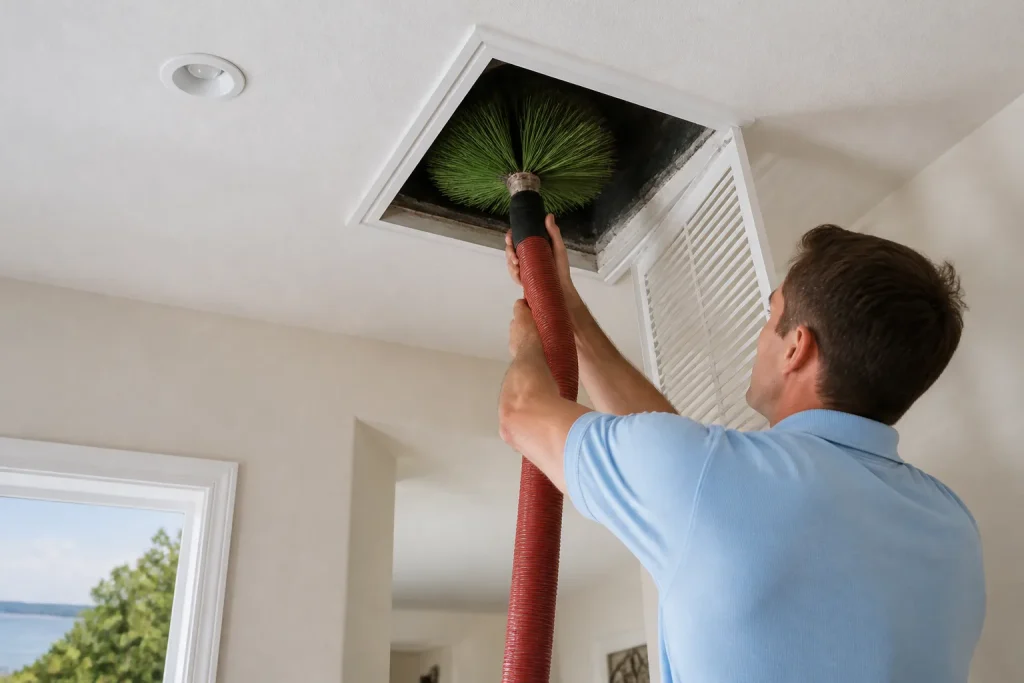
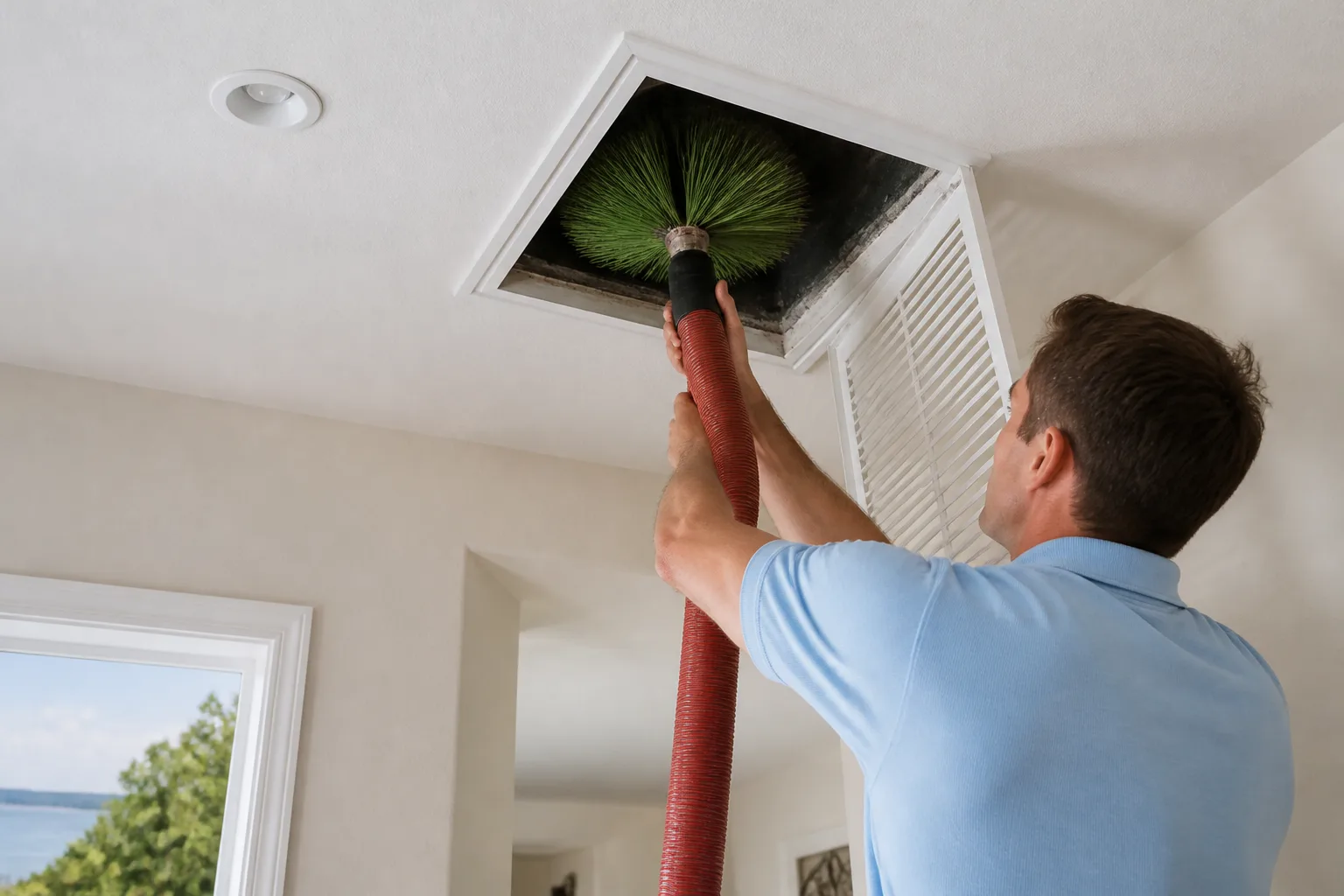
That contrast is the whole point. Surface dust on a register is a fact of life. Debris actively coming out of the duct means the interior walls have lost whatever smoothness they had. When we inspect a West Seattle home, we use a Rotobrush rotary brush extraction system to look inside the run itself rather than judging by the register cover. Professional-grade equipment sees what a white cloth can only hint at.
Airflow Patterns That Reveal a Partial Blockage
Weak airflow from one register while the rest of the house feels fine is easy to misdiagnose as a failing HVAC system. In our experience it’s usually a partial blockage in a single branch run, not a system-wide problem. The distinction matters because one is a duct cleaning job and the other may be equipment.
Try this. Walk the house with your hand in front of each register while the fan runs:
- One or two weak registers, the rest strong: a branch run has a restriction. Debris settling at a bend, a crushed flexible duct, or a disconnected joint inside a wall.
- Every register feels weak at once: the restriction is at the filter, the return, or the blower. Clean the filter first, then reassess.
- Strong at the register closest to the furnace, weak farther out: classic sign of pressure loss along the run, often from leaks or heavy buildup in the main trunk.
- Whistling or a rattle at one grille: partial blockage forcing air through a smaller opening than intended.
We’ve seen plenty of West Seattle homes where a homeowner replaced a filter six times before realizing the trunk line was the problem. Matching the symptom to the right location is what saves the second call. A full air duct cleaning pass with HEPA-filtered extraction brings the entire distribution system back to a known baseline, so the next weak register is easy to trace.
The Smell Test for Moisture Conditions at Duct Connections
West Seattle’s damp air shows up in duct systems at the joints. When a connection point isn’t sealed tight, moisture accumulates where the duct meets a floor cavity, a crawlspace, or an exterior wall. You don’t need to open anything to check for it. You need a still morning and a good nose.
Turn the fan off and put your face near a supply register. Then run the system for a minute and smell the air again. What you’re noting is the difference:
- Musty, earthy, or damp-basement smell inside the duct: moisture is present and biological growth may be developing on interior surfaces or at an unsealed joint.
- Smell is stronger at one or two registers: points to a connection point near those runs rather than the whole system.
- Smell appears only when the fan runs: the odor is being pulled from the duct cavity, not the room.
- No smell, consistent airflow: no immediate moisture signal, though a sealing check is still worth it.
We use Nikro HEPA-filtered vacuum equipment because pulling debris out of a moist duct without containing the fine particulate just redistributes it into the room. When contamination is elevated, Abatement Technologies equipment gives us the particulate control to handle it properly. We seal what we find, because a joint that let moisture in will let it in again after a cleaning. That’s why duct repair and sealing is part of the same visit rather than a referral.
The Post-Renovation Clue Most Homeowners Miss
Drywall dust does not stay in the room where the drywall went up. It drifts. And your HVAC filter does not stop it. Fine gypsum and joint compound particles are smaller than what a standard filter catches, so during any remodel they migrate into return air, coat the interior walls of your ducts, and settle in the branches directly downstream of the returns closest to the work.
Here’s the part that catches people out. The filter looks fine when the job ends. The rooms look clean. But the ducts hold a thin, powdery residue that gets stirred back into the living space every time the blower runs. In West Seattle, where many homes have had a bathroom, kitchen, or basement modeled in the last few years, that residue is often still in the system long after the paint dries.
Signs to watch for after a remodel:
- White or pale-gray dust settling faster than usual on horizontal surfaces in rooms near the work.
- A chalky, flat smell from registers when the heat or AC first kicks on.
- Airflow that feels weaker than before the renovation started.
HVAC cleaning after a remodel is standard for commercial projects but almost never done in a house. If you’ve finished a renovation within the last year or two and the dust never really settled, that’s the reason. And if your dryer has been running slow or smelling hot, the lint side of the equation matters for the same reason: a dryer vent cleaning is the fastest way to rule out a blocked exhaust.
Why a New HVAC System Can Still Have Dirty Ducts
New furnace, new coils, new air handler, and the air still tastes off. It’s more common than the installers advertise. Replacing the equipment doesn’t touch the distribution system. You’ve inherited clean machinery connected to the same ductwork that fed the old unit for however many years it ran. New equipment equals clean production. It does not equal clean delivery.
In our experience with recently installed systems in West Seattle, the signs to watch are:
- Fresh filter, weak air from registers: the ducts are the bottleneck, not the furnace.
- Brand-new equipment but the same smell as before: the odor lives in the ducts, not the unit.
- Filter is clean on schedule but dust keeps settling: debris inside the duct is bypassing the filter.
- Repeated short cycling from a high-efficiency system: may indicate airflow restriction upstream of the blower.
Cleaner air starts with the right tools, and a new system deserves a clean air pathway from intake to output. We install Honeywell and Aprilaire air quality hardware alongside cleaning when a homeowner wants filtration that actually matches what the equipment can deliver. It’s the difference between a system that runs and a system that breathes.
When to Call a Pro
If your white cloth test shows debris discharge, your smell test points toward moisture at a joint, or a post-renovation dust problem hasn’t cleared in a season, it’s time for an inspection. Those are the moments where clearing your own duct yourself risks pushing debris deeper or breaking a joint you can’t see. The system is hidden behind walls and floors for good reason.
If you’d rather not crawl around the basement with a flashlight, that’s a reasonable call. Our technicians have up to 8 years of experience, and we bring professional-grade extraction equipment to every job, not a shop vac and a hose. We agree on one flat price per system before work starts and show you before-and-after photos of your own ducts. If you’re in West Seattle and need help, Air Duct Cleaning West Seattle offers free estimates. One crew covers ducts, dryer vents, HVAC units, sealing, and sanitizing under one roof, so you don’t need a second contractor to finish the job.
The Bottom Line
The useful signs of a dirty duct system aren’t “dusty house” and “allergies.” They’re a white cloth that picks up specks when the fan runs, a register that’s noticeably weaker than its neighbors, a musty smell that only shows up when the blower is on, and dust that never cleared after a renovation. Any one of those is worth an inspection. Two or more in the same home, in our experience, usually means the job is overdue.
If you’re in West Seattle and need help, Air Duct Cleaning West Seattle offers free estimates. Call (877) 492-4032. We answer 24/7. Fast dispatch from 7am to 7pm, Sunday through Friday.
Frequently Asked Questions
There’s no fixed interval that fits every home. Three things push a system toward cleaning: a recent renovation that pushed drywall dust through the returns, a moisture problem at the joints, or a visible discharge test that comes back positive. A home with none of those can go years between cleanings. A home with one of them should be inspected sooner rather than later. Call (877) 492-4032 for a free estimate.
Cheap quotes usually skip the extraction and the containment. A shop vac and a price-match coupon won’t pull debris off interior duct walls, and it won’t hold fine particulate while it does. We work with professional equipment: Rotobrush, Nikro HEPA-filtered extraction, and Abatement Technologies when contamination is elevated. It shows up in the price and in the result. Call (877) 492-4032 for a free estimate.
Ask for before-and-after photos of your own ducts, not a stock gallery. Take a look inside a return before the job and again after. And confirm one agreed flat price per system before the work starts, so there’s no surprise on the invoice. That’s how we run every job. Call (877) 492-4032 for a free estimate.
Pricing depends on the size of the system, the number of supply and return runs, and whether repair or sealing is needed. We set the price per system by written estimate, agreed before work begins, so you know the total up front. What you’ll never get from us is a per-vent price or a teaser coupon. Call (877) 492-4032 for a free estimate.
Written by the team at Air Duct Cleaning West Seattle.
Need Air Duct Cleaning Help?
Call Air Duct Cleaning West Seattle - the local pro we connect you with is licensed and insured, with free written estimates in West Seattle.
(877) 492-4032