
Rotobrush Air Duct Cleaning in West Seattle: A Homeowner’s Guide
Rotobrush equipment is genuinely used by professional duct cleaners. But the brand name on the machine tells you less than you think. The technique, the CFM of the integrated vacuum, and the operator’s familiarity with your duct type determine the actual result. Plenty of West Seattle homeowners book a Rotobrush service expecting a fixed outcome and get a very different one, because nobody asked what kind of duct the house has. If you’d rather not sort that out alone, call (877) 492-4032.
This guide explains how the machine actually works, where it excels, where it falls short, and what to ask before you book.
How Does the Rotobrush System Actually Work?
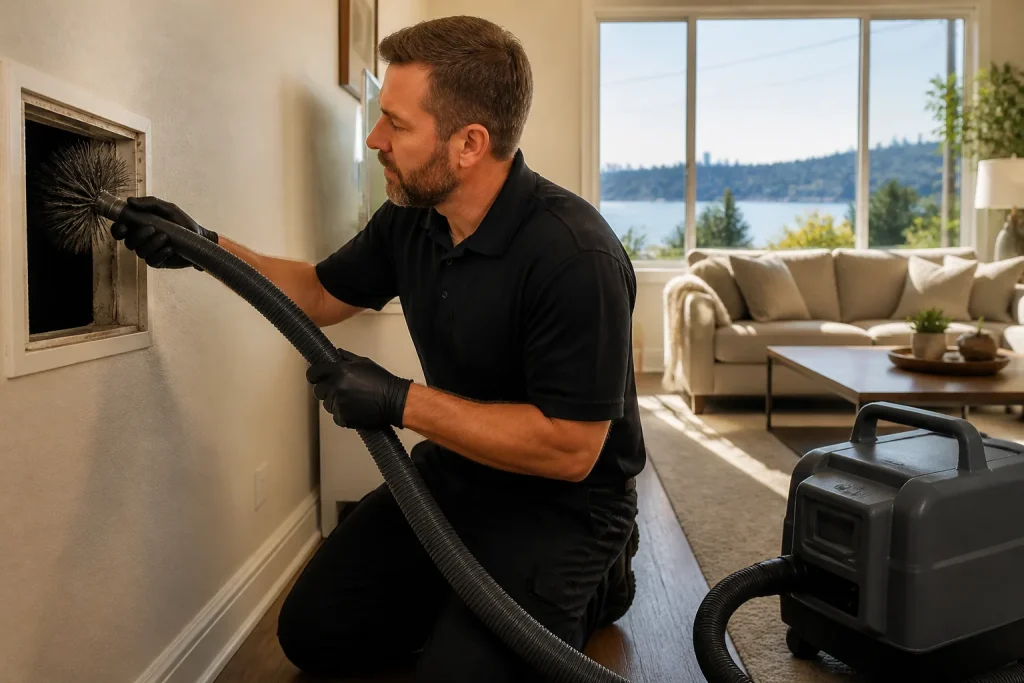
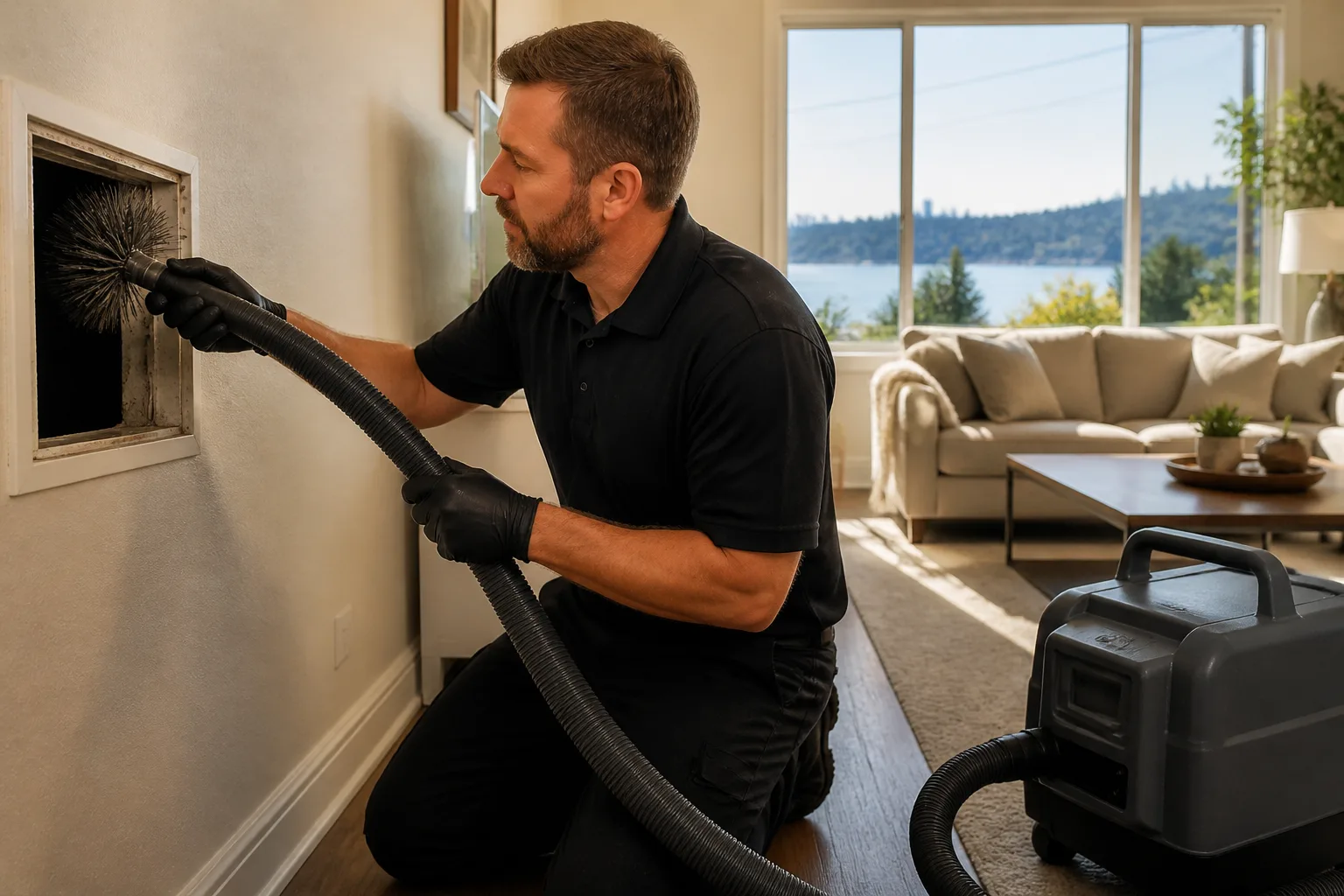
Rotobrush combines brush agitation with simultaneous vacuum extraction in one pass. A rotating brush head travels down the duct, loosening debris from the walls, while a vacuum hose attached to the same assembly pulls that debris out as it goes. Agitation and capture happen at the same time, in the same place.
That’s different from pure negative pressure cleaning, which relies on a large vacuum pulling air through the whole system and hoping the debris comes loose along the way. Negative pressure works well when debris is already light and dry. It struggles with anything stuck to the duct wall: dust caked by years of slight condensation, pet hair matted into a return, lint that has bonded to flex liner.
The brush handles that. The vacuum handles the rest. Neither is much use without the other.
One detail worth knowing: Rotobrush systems are portable and source their power from a standard outlet, with the vacuum unit integrated into the machine. That’s a real advantage in West Seattle homes where the air handler sits in a tight crawlspace or a closet off a hallway and a truck can’t get close. It’s not a replacement for a truck-mounted unit in every situation, and any honest operator will tell you so.
Where Rotobrush Performs Best in West Seattle Homes
Rotobrush is at its strongest in rigid sheet metal ductwork with accessible trunk lines. If your West Seattle house has galvanized rectangular trunk runs and round metal branches, the brush has a clean, predictable path and the vacuum can keep up.
That describes a lot of the housing stock in neighborhoods like Fauntleroy and Gatewood, where mid-century construction often used metal trunk and branch systems. In those homes, a Rotobrush pass on each branch run, followed by trunk work, reaches the full length of the duct with good agitation.
It also performs well on:
- Accessible trunk lines where the operator can open a plenum and work down each branch individually.
- Systems with short, straight runs where the brush head doesn’t need to negotiate tight turns.
- Ducts with light to moderate dust loading and no heavy liner damage.
- Returns and supplies where the register boot is standard and the brush head fits properly.
The pattern is simple: the more rigid and accessible the duct, the better the Rotobrush result.
Where Rotobrush Limitations Show Up
Heavily corrugated flex duct is where things get interesting, and not always in a good way. Flex duct has a ribbed interior that traps debris in the corrugations. A rotating brush can agitate that material loose, but the brush head also has to travel through a tube that bends and pinches. In tight branch runs, common in West Seattle homes that have been retrofitted with flex during a remodel or heat pump conversion, the brush may not reach the last several feet of the run.
Irregular branch geometry is the other issue. Older West Seattle houses sometimes have duct layouts that were modified over the years: a branch added here, a run rerouted there, a transition that doesn’t match anything in a manufacturer’s diagram. A brush follows the duct, but it can’t follow a duct that has a hard 90-degree turn inside a wall cavity.
In those situations, the machine’s limitation isn’t a defect. It’s just physics. The operator needs to know when to stop brushing and switch methods.
This is also the point where liner damage matters. A brush run at the wrong speed or pressure through aging flex liner can tear it. That damage isn’t visible from the register, and it can let conditioned air escape into a wall cavity.
Why “We Use Rotobrush” Is an Incomplete Answer
If a company leads with “we use Rotobrush” and stops there, you’ve learned one thing: they own or have access to a machine. You haven’t learned whether the job will be done well.
What to ask instead:
- What’s the CFM of your vacuum unit? Brush agitation without adequate airflow just moves debris around inside the duct. The vacuum has to be sized to the system.
- How do you handle the air handler and coil? Ducts connect to equipment. If the coil and blower aren’t cleaned or protected during the job, you’ve cleaned one half of the system.
- Do you seal breaches you find? Cleaning a leaking duct system is temporary work. The leaks return the dust. Ask whether duct repair and sealing is part of their service or a referral to someone else.
- What does your before-and-after documentation look like? Photos of the register face aren’t documentation. You want to see inside the run.
- What happens if the brush can’t reach the end of a flex run? The answer tells you whether they’ll use a different method or just call it done.
In our experience, the operators who can answer those questions clearly are the ones who’ve spent real time inside West Seattle duct systems and know what they’re looking at.
How to Evaluate Before-and-After Documentation
Good documentation shows the interior of the duct, not the register cover. Ask to see photos or video taken inside the run, ideally at the far end, where debris accumulates and where a brush may not reach.
Look for these markers:
- Interior shots of supply branches, not just the trunk.
- Shots of the return side, which is often the dirtiest part of the system.
- Images taken at the same point before and after, so you can compare.
- Visible evidence of the full run length, including the last few feet before the register boot.
A photo of a shiny register grill proves the technician wiped a grill. That’s not the same thing.
If a company can’t produce interior documentation, that’s your answer about how thorough the job will be. Professional-grade extraction equipment and honest documentation travel together; one without the other is a red flag.
When a Combined Approach Beats Rotobrush Alone
Sometimes the right answer is both methods, not one or the other. Rotobrush agitation loosens what’s bonded to the duct wall. A high-volume negative pressure unit, or Abatement Technologies equipment in elevated contamination scenarios, pulls that loosened material out of the system entirely.
The combined approach makes sense when:
- The system has long trunk runs where a portable vacuum can’t maintain airflow across the full distance.
- There’s heavy particulate loading, such as after a renovation or in a home with a long-neglected return.
- Flex duct runs are difficult to reach and need agitation followed by strong extraction.
- Contamination levels call for HEPA-filtered containment, which is where Nikro and Abatement Technologies equipment come in.
A company that only has one machine will always recommend the job its machine can do. A company with the full equipment set can match the method to your ductwork. That’s the difference between a service and a sales pitch.
When to Call a Pro
If you’re comfortable checking register faces and looking for visible dust, that’s a reasonable start. But if you’re seeing dust settling on surfaces shortly after cleaning, noticing musty odors when the system runs, or dealing with a household member whose allergies flare when the heat comes on, those are signs the system needs a proper look.
Flex duct damage and liner tears are also worth a professional inspection; a brush in the wrong hands can make that worse, not better. The same goes for anything touching the air handler or coil, which should be handled by someone who knows the equipment.
Related services in West Seattle: if the ducts are part of a bigger picture, it’s worth looking at HVAC cleaning and dryer vent cleaning at the same time.
What Full Air-Pathway Coverage Looks Like
A duct cleaning that stops at the supply registers is half a job. The air pathway runs from the return grille through the return trunk, into the air handler, across the coil, through the supply trunk, and out every branch to every register. Debris anywhere along that path ends up in your living space.
That’s why we approach air duct cleaning as a whole-system service rather than a per-vent task. It covers supply and return ducts, the air handler and coil, and the duct repair and sealing that closes breaches found during the job.
For homeowners thinking about long-term air quality, installing Honeywell or Aprilaire filtration alongside a cleaning is a practical next step. Clean ducts plus proper filtration does more for indoor air than either alone.
You can see the full scope of what we offer at Air Duct Cleaning West Seattle.
The Bottom Line
Rotobrush is a legitimate, professional-grade system, and it’s the right tool for a lot of West Seattle ductwork. But the name on the machine isn’t the whole story. The vacuum’s airflow, the operator’s judgment about your specific duct type, and whether the company can handle the air handler, the coil, and any breaches they find all matter more than the logo.
Ask the five questions above before you book. Look for interior documentation. And if your home has older flex duct or an unusual branch layout, ask how they handle runs the brush can’t reach.
If you’re in West Seattle and need help, Air Duct Cleaning West Seattle offers free estimates. Call (877) 492-4032. We answer 24/7. Fast dispatch from 7am to 7pm, Sunday through Friday. Our technicians have up to 8 years of experience, and every job starts with a written estimate that sets the final price.
Frequently Asked Questions
Rotobrush is a professional-grade rotary brush extraction system used by duct cleaning companies, not a consumer vacuum. It combines brush agitation with integrated vacuum extraction in one pass. That said, owning the machine doesn’t guarantee a good result; the operator’s technique and the vacuum’s airflow matter just as much. Call (877) 492-4032 for a free estimate on your West Seattle home.
Cost depends on system size, duct type, and accessibility, so there’s no single number that fits every home. We price per system, not per vent, and the written estimate you receive before work starts is the price you pay. That avoids the bait-and-switch pattern of a low coupon that grows once the technician is on site. Call (877) 492-4032 for an exact quote; estimates are free.
Ask for interior photos or video of the duct runs, before and after, taken at the same points. Register-face photos don’t count. If a company can’t show you the inside of the run, ask why. Call (877) 492-4032 to see what our documentation looks like.
There’s no fixed schedule that applies to every home. Homes with pets, recent renovations, or household members with allergies often benefit from more frequent attention; a well-maintained system with good filtration may go longer. The honest answer is that it depends on what’s in your ducts, which is why an inspection comes first. Call (877) 492-4032 for a free estimate.
Written by the team at Air Duct Cleaning West Seattle.
Need Air Duct Cleaning Help?
Call Air Duct Cleaning West Seattle - the local pro we connect you with is licensed and insured, with free written estimates in West Seattle.
(877) 492-4032