
Emergency Air Duct Cleaning Near Me: What West Seattle Homeowners Should Do First
Calling a duct cleaner first after a rodent infestation or a sewage backup is the wrong move. Until the contamination source is isolated, running your HVAC system, or letting a technician connect vacuum equipment, can pull pathogens and particulate into every room of the house. What you do in the first half hour matters more than who you call. This guide walks through the triage sequence for West Seattle homeowners, in order, so contamination stays contained and your insurance claim stays clean.
If you’d rather skip the DIY triage and get a trained eye on the system, call (877) 492-4032. We answer 24/7. Fast dispatch from 7am to 7pm, Sunday through Friday. Estimates are free, and the written estimate sets the price before any work starts.
Key Takeaways
- Shut the HVAC system off at the thermostat and at the breaker before you do anything else.
- Isolate the source: seal the affected register or return with plastic and tape so the system can’t pull contamination further in.
- Photograph and document before you clean, not after. Your insurance carrier needs the “before” state.
- Only a handful of situations qualify as a true duct emergency. Most urgent-sounding calls are urgent, not emergency-tier.
- Speed is not the same as readiness. Ask what containment equipment the company carries before you authorize work.
What Actually Counts as an Emergency Duct Situation?
A genuine duct emergency is a contamination event inside the air pathway that can spread through the whole house if the system runs: rodent or bird intrusion, fire and smoke residue, sewage backup reaching the ducts, or standing water and microbial growth inside the system. Those four are emergency-tier. A dusty smell, a renovation, or a high energy bill are urgent but not emergencies. They can wait for a scheduled appointment.
Here’s how we separate the two, because the difference changes what you should do in the next thirty minutes:
- Rodent or bird intrusion. Droppings, nesting material, or a carcass inside a duct. Emergency-tier because rodent waste carries pathogens that aerosolize the moment air moves.
- Fire and smoke residue. Soot in the supply runs after a house fire. Emergency-tier because soot is acidic and the HVAC system will redistribute it across every surface.
- Sewage backup contamination. Water and waste that reached a floor register or a return. Emergency-tier and a health concern, not a comfort concern.
- Standing water or visible mold in the air pathway. Emergency-tier. Moisture inside a duct is a growth problem that gets worse by the day.
- Musty odor, dust buildup, recent renovation debris. Urgent, schedule it soon, but you don’t need to isolate the system tonight.
The line is simple: if the contamination can travel through the ducts and you have no way to stop it, treat it as an emergency. If it’s a comfort or efficiency issue, treat it as a scheduling issue. Getting that call right saves you money and protects your family.
What Should You Do in the First 30 Minutes?
Turn the system off, isolate the source, and start documenting. In that order. Do not run the fan “to clear the air.” Do not spray air freshener into a register. Do not let anyone connect a vacuum to a contaminated system before the source is sealed off. Each of those moves spreads the problem.
Here’s the sequence we walk homeowners through:
- Shut the HVAC system off at the thermostat first, then at the breaker for the air handler. You want zero air movement through the ducts.
- Isolate the source. If the contamination is at a specific register or return, cover it with heavy plastic sheeting and tape the edges. If it’s at the air handler, seal the unit’s access panel the same way.
- Close interior doors to the affected rooms and keep pets and children out.
- Put on gloves, an N95 respirator, and eye protection before you get near the affected area. This is not a bare-hands job.
- Document everything. Photograph the register, the duct interior if you can see it safely, any droppings or staining, and the surrounding surfaces. Note the date and time you shut the system down.
- Call your insurance carrier and open a claim before you authorize any cleaning. More on that below.
The documentation step is the one most homeowners skip, and it’s the one that protects the claim. A carrier wants the before state, the cause, and the timeline. Once a cleaning crew has been through, the evidence is gone. Take the photos first.
Why Isn’t the Fastest Company Always the Right Choice?
Because emergency duct work is a containment job before it’s a cleaning job. A company that arrives in an hour with a shop vac and a hose can make a rodent or sewage situation measurably worse by stirring contamination into the air before it’s captured. What you actually need on site is HEPA-filtered extraction, negative pressure containment if the contamination is significant, and a technician in proper PPE who knows the difference between cleaning a duct and remediating one.
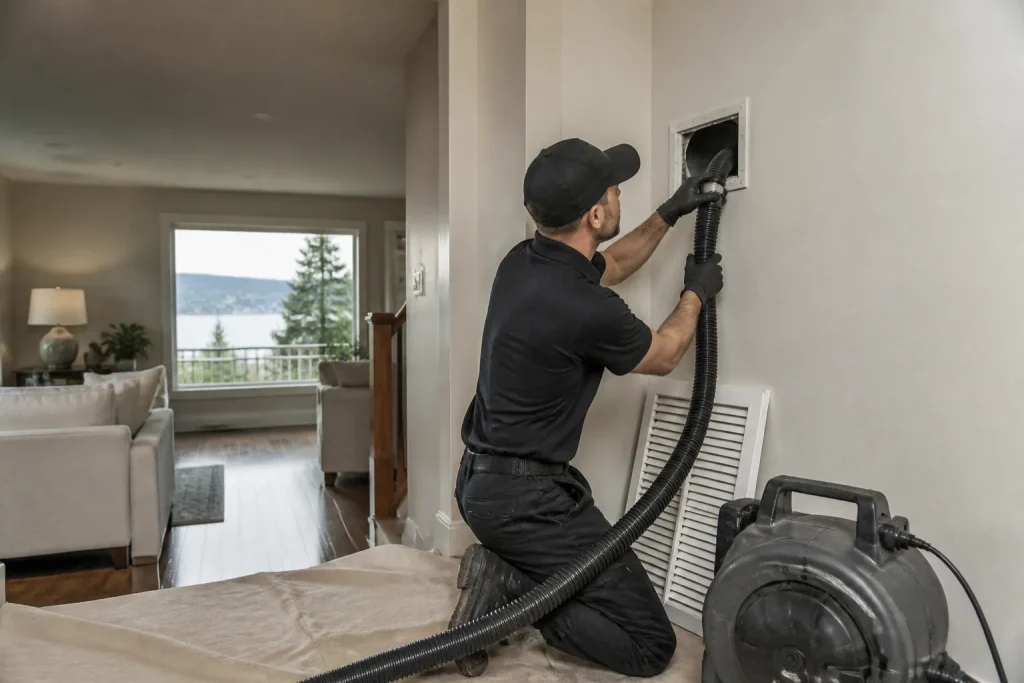
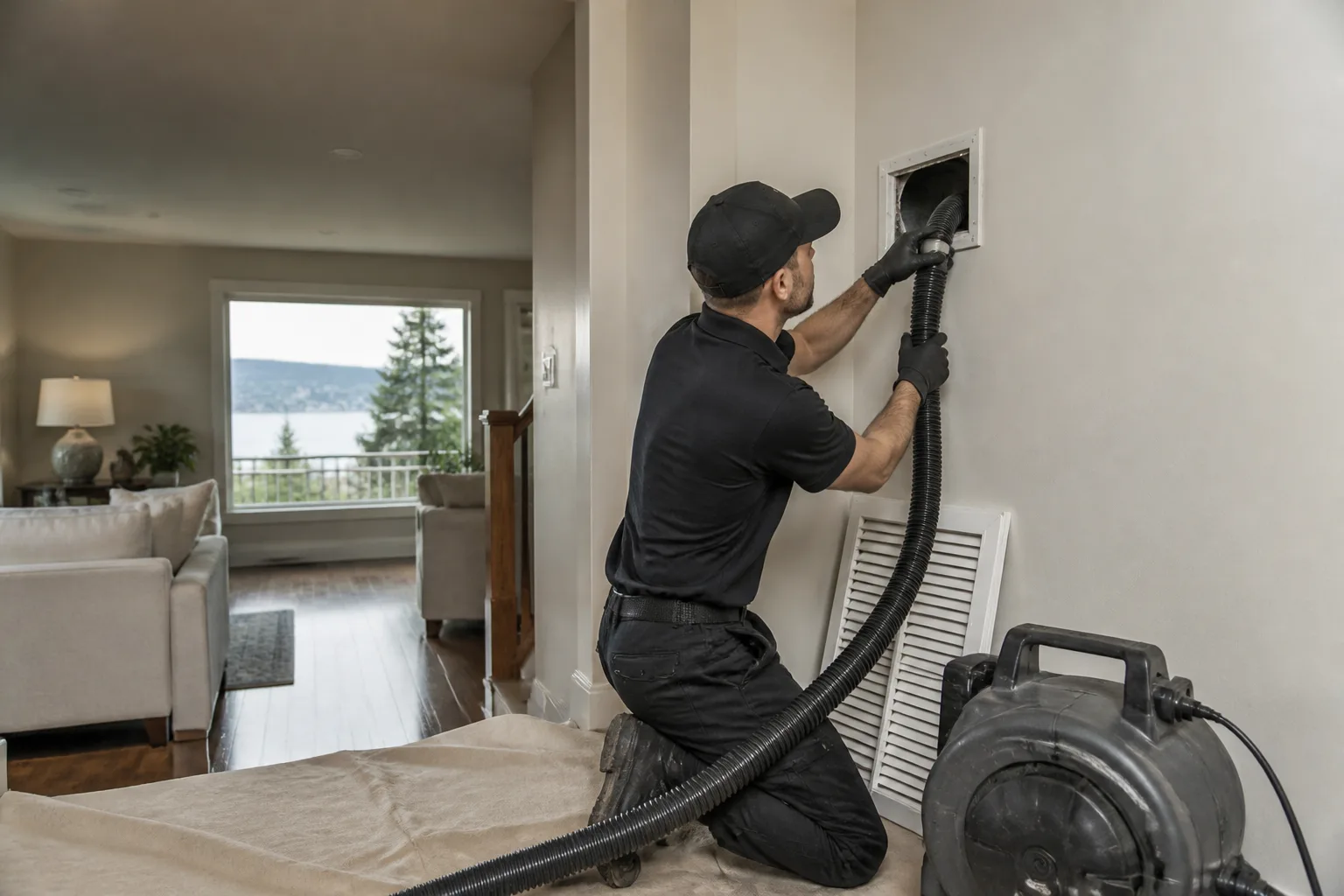
This is where equipment matters, and it’s the part homeowners can’t see in a quote. Professional-grade duct work uses rotary brush extraction and HEPA-filtered vacuum equipment, the same class of tools that industrial hygienists and HVAC contractors specify for commercial and remediation-grade projects. In our experience, the brands that show up in that class are the ones worth asking about by name: Rotobrush rotary brush systems for the extraction itself, Nikro HEPA-filtered vacuums for particulate containment, and Abatement Technologies equipment for elevated contamination and particulate control beyond surface-level duct wiping. A company that can name its equipment and explain what it does for containment is usually a company that understands the job.
Ask three questions before you authorize anything:
- What HEPA filtration are you using, and what’s its rating?
- How will you contain particulate so it doesn’t spread to the rest of the house?
- Can you repair and reseal any breach you find, or do I need to call a second contractor?
That last question matters more than people expect. Contamination often enters through a failed seal or a disconnected joint. A clean-only company can clean the duct and leave the breach that let the problem in, which means you’ll be doing this again. Duct Repair & Sealing belongs in the same visit as the cleaning. We seal what we find, and we don’t hand you off to a third party to do it.
How Do You Verify a Company Is Equipped for Contamination Work?
Ask for the equipment list, the containment plan, and the PPE protocol, in writing, before anyone arrives. A company equipped for contamination remediation can answer those three items specifically and without a sales pitch. A company that only does standard cleaning will get vague and steer the conversation back to price. That’s your signal.
Here’s what a properly equipped response looks like:
- HEPA containment. The vacuum uses true HEPA filtration, and the technician sets up containment or negative pressure where the contamination level calls for it.
- PPE protocol. Respirators, gloves, eye protection, and protective clothing appropriate to the contamination type. Not a dust mask.
- Post-cleaning verification. After the work, the company can verify the system is clean (visual inspection through access points, and air sampling where contamination was elevated). You should receive before-and-after photos of your own ducts, not stock images.
- Full air-pathway scope. Supply and return ducts, the air handler, the HVAC unit itself, and post-clean sanitizing where contamination warrants it.
For a broader look at how a full-system air duct cleaning works from intake to output, our service page walks through the process step by step. The same containment thinking applies to HVAC cleaning, because a clean duct connected to a dirty coil just re-contaminates the system. And if the emergency is in the dryer vent line (lint buildup, a scorched smell, or a blocked exhaust), that’s a fire-safety concern that belongs on its own track: see dryer vent cleaning. You can find the full service menu on our Air Duct Cleaning West Seattle home page.
What Should You Tell Your Insurance Carrier Before Authorizing Work?
Tell them the cause, the date you first noticed it, and the exact scope you believe is affected. Then get a claim number and the name of the adjuster before you sign anything with a cleaning company. Insurance carriers handle contamination claims very differently from general cleaning claims, and the documentation you provide in the first conversation shapes the whole claim.
Here’s what protects the claim:
- Photographs and video of the affected registers, ducts, and surrounding damage, taken before any cleaning.
- The cause in plain language (“rodent intrusion at the return in the hallway,” “sewage backup reached the floor register”).
- Your written documentation of the date and time the system was shut down, and who performed the shutoff.
- An itemized written estimate from the cleaning company that separates cleaning, containment, repair and sealing, and sanitizing.
- The claim number and adjuster contact in hand before work begins.
One more thing: ask the carrier whether the work needs pre-authorization, and whether they want their own adjuster to inspect before cleaning starts. Some do. Getting that answered up front avoids a dispute later. A licensed and insured local pro, the kind we connect homeowners with, will work with your insurer and provide the documentation the claim needs; what we won’t do is tell you how your policy reads, because that’s a conversation for your adjuster.
If you’re in West Seattle and need help, Air Duct Cleaning West Seattle offers free estimates. Call (877) 492-4032. We answer 24/7. Fast dispatch from 7am to 7pm, Sunday through Friday, and we’re closed Saturday. Our technicians have up to 8 years of experience, and the price is one flat price per system, agreed in the written estimate before work starts. No per-vent pricing, no bait-and-switch coupon that becomes a bigger invoice once the technician is on site. You get before-and-after photos of your own ducts.
The Bottom Line
The order is the whole game: shut the system off, isolate the source, document everything, call your carrier, and only then bring in a cleaning company. Get that sequence right and a true duct emergency stays contained. Skip it and a manageable problem becomes a whole-house contamination event. Most homeowners who call us in a panic have already made one good decision (turning the system off) and one bad one (calling around for the fastest company instead of checking equipment). We’ve seen both, and the second is the one that costs money.
If you’re facing a rodent intrusion, a sewage backup that reached a register, smoke residue after a fire, or visible growth in the air pathway, and you’re in West Seattle, call us. We’ll walk you through containment over the phone and set up a free estimate. Call (877) 492-4032. We answer 24/7. Fast dispatch from 7am to 7pm, Sunday through Friday, closed Saturday.
Frequently Asked Questions
Shut the HVAC system off at the thermostat and the breaker, seal the affected register or return with plastic and tape, and put on gloves and a respirator before you go near it. Then document the scene with photos and call your insurance carrier. Do not run the fan to “clear the air,” and do not let anyone vacuum the duct before the source is contained. If you’re in West Seattle and want a trained eye, call (877) 492-4032.
A single-system cleaning with containment typically runs in the several-hundred-dollar range for a standard house, and a contamination or remediation job runs higher because of the containment, PPE and verification steps involved. A true emergency isn’t a flat quote; it depends on the source, the affected scope, and whether repair and resealing is needed. The written estimate sets the final price, and estimates are free. Call (877) 492-4032 for an exact quote.
Because a low quote usually reflects a shop vac and a hose rather than HEPA containment, and it rarely includes repair, resealing, or post-cleaning verification. That’s not a knock on a fair price; it’s a question of scope. Ask what equipment and containment are included, and whether the quote covers duct repair and sealing if a breach is found. A cheap quote that leaves the breach in place means you’ll be doing this again. Call (877) 492-4032 to talk through what your situation actually needs.
Before-and-after photos of your own ducts, a written scope of what was cleaned, and a verification step (visual inspection through access points, and air sampling where contamination was elevated). Ask for the photos before anyone leaves. A company confident in its equipment will show you the work. If you’re in West Seattle and want to see what that looks like, call (877) 492-4032. Estimates are free.
Written by the team at Air Duct Cleaning West Seattle.
Need Air Duct Cleaning Help?
Call Air Duct Cleaning West Seattle - the local pro we connect you with is licensed and insured, with free written estimates in West Seattle.
(877) 492-4032